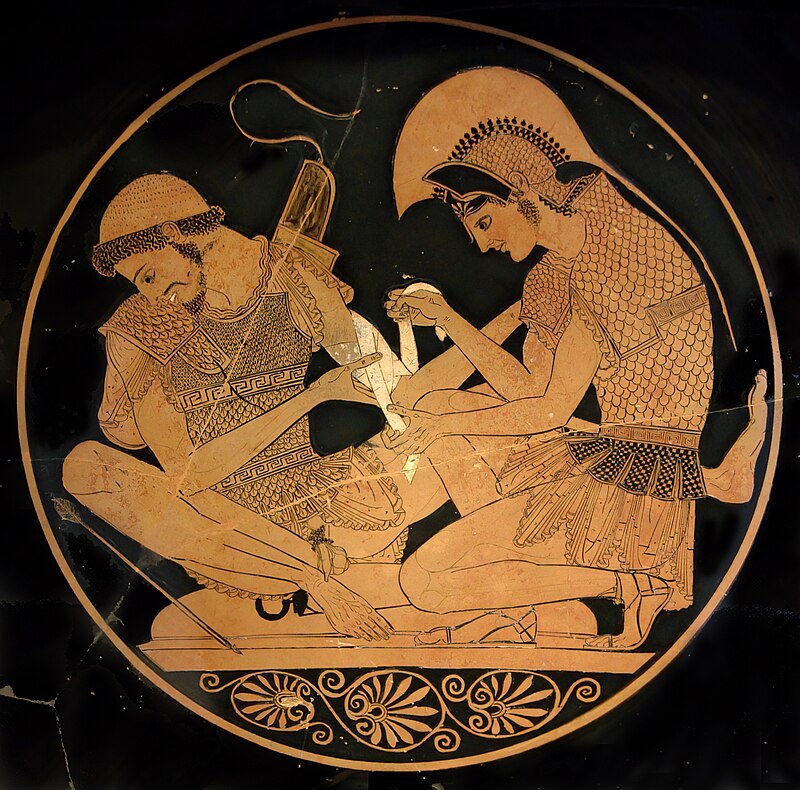
In Greek mythology, the Trojan War was waged against the city of Troy by the Achaeans (Greeks) after Paris of Troy took Helen from her husband Menelaus, king of Sparta. The war is one of the most important events in Greek mythology and has been narrated through many works of Greek literature, most notably through Homer's Iliad. The Iliad relates four days in the tenth year of the decade-long siege of Troy; the Odyssey describes the journey home of Odysseus, one of the war's heroes. Other parts of the war are described in a cycle of epic poems, which have survived through fragments. Episodes from the war provided material for Greek tragedy and other works of Greek literature, and for Roman poets including Virgil and Ovid.
Achilles

In Greek mythology, Achilles was a Greek hero of the Trojan War and the central character and greatest warrior of Homer's Iliad. His mother was the immortal nymph Thetis, and his father, the mortal Peleus, was the king of the Myrmidons.
Achilles’ most notable feat during the Trojan War was the slaying of the Trojan hero Hector outside the gates of Troy. Although the death of Achilles is not presented in the Iliad, other sources concur that he was killed near the end of the Trojan War by Paris, who shot him in the heel with an arrow. Later legends (beginning with a poem by Statius in the 1st century AD) state that Achilles was invulnerable in all of his body except for his heel. Alluding to these legends, the term "Achilles heel" has come to mean a point of weakness, especially in someone or something with a strong constitution.
Homer
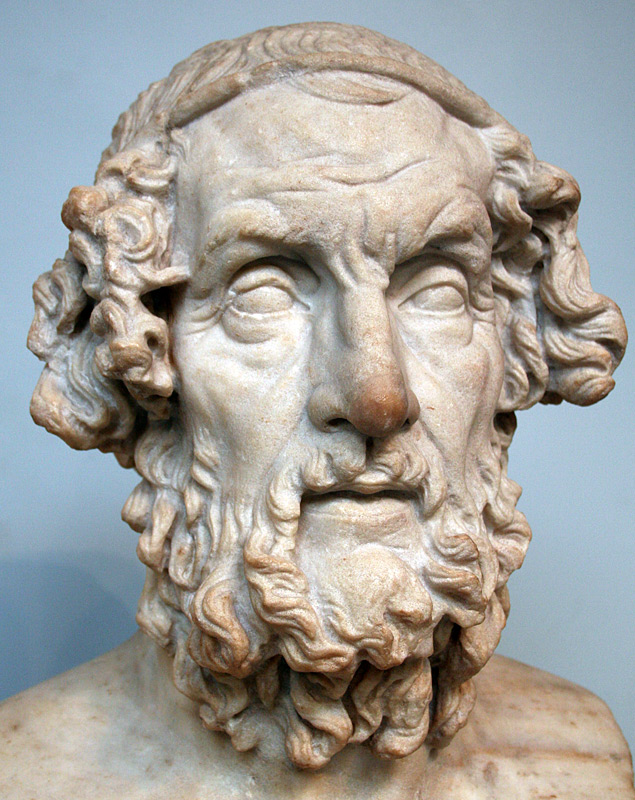
Homer is the name ascribed by the Ancient Greeks to the semi-legendary author of the two epic poems, the Iliad and the Odyssey, the central works of Greek literature. Many accounts of Homer's life circulated in classical antiquity, the most widespread being that he was a blind bard from Ionia, a region of central coastal Anatolia in present-day Turkey. The modern scholarly consensus is that these traditions do not have any historical value.
Hector

In Greek mythology, Hector was a Trojan prince and the greatest fighter for Troy in the Trojan War. As the first-born son of King Priam and Queen Hecuba, who was a descendant of Dardanus and Tros, the founder of Troy, he was a prince of the royal house and the heir apparent to his father's throne. He was married to Andromache, with whom he had an infant son, Scamandrius (whom the people of Troy called Astyanax). He acted as leader of the Trojans and their allies in the defense of Troy, "killing 31,000 Greek fighters", offers Hyginus. During the European Middle Ages, Hector figures as one of the Nine Worthies noted by Jacques de Longuyon, known not only for his courage but also for his noble and courtly nature. Indeed, Homer places Hector as peace-loving, thoughtful as well as bold, a good son, husband and father, and without darker motives. James Redfield writes of Hector as a "martyr to loyalties, a witness to the things of this world, a hero ready to die for the precious imperfections of ordinary life.''
Aphrodite

Aphrodite is the Greek goddess of love, beauty, pleasure, and procreation. Her Roman equivalent is the goddess Venus. She is identified with the planet Venus.
As with many ancient Greek deities, there is more than one story about her origins. According to Hesiod's Theogony, she was born when Cronus cut off Uranus's genitals and threw them into the sea, and she arose from the sea foam (aphros). According to Homer's Iliad, she is the daughter of Zeus and Dione. According to Plato (Symposium, 180e), these two origins were of entirely separate entities: Aphrodite Ourania and Aphrodite Pandemos.
Because of her beauty, other gods feared that their rivalry over her would interrupt the peace among them and lead to war, so Zeus married her to Hephaestus, who, because of his ugliness and deformity, was not seen as a threat. Aphrodite had many lovers—both gods, such as Ares, and men, such as Anchises. She played a role in the Eros and Psyche legend, and later was both Adonis's lover and his surrogate mother. Many lesser beings were said to be children of Aphrodite.
Twelve Olympians
| Greek name | Roman name | Image | Functions and attributes |
|---|---|---|---|
| Zeus | Jupiter |  | King of the gods and ruler of Mount Olympus; god of the sky, lightning, thunder, law, order, justice. Youngest child of the Titans Cronus and Rhea. Symbols include the thunderbolt, eagle, oak tree, scepter, and scales. Brother and husband of Hera, although he had many lovers, also brother of Poseidon, Hades, Demeter, and Hestia. |
| Hera | Juno |  | Queen of the gods and the goddess of marriage and family. Symbols include the peacock, cuckoo, and cow. Youngest daughter of Cronus and Rhea. Wife and sister of Zeus. Being the goddess of marriage, she frequently tried to get revenge on Zeus' lovers and their children. |
| Poseidon | Neptune |  | God of the seas, earthquakes, and tidal wave. Symbols include the horse, bull, dolphin, and trident. Middle son of Cronus and Rhea. Brother of Zeus and Hades. Married to the Nereid Amphitrite, although, like most male Greek Gods, he had many lovers. |
| Demeter | Ceres |  | Goddess of fertility, agriculture, nature, and the seasons. Symbols include the poppy, wheat, torch, cornucopia, and pig. Middle daughter of Cronus and Rhea. |
| Athena | Minerva |  | Goddess of wisdom, reason, intelligent activity, literature, handicrafts and science, defense and strategic warfare. Symbols include the owl and the olive tree. Daughter of Zeus and the Oceanid Metis, she rose from her father's head fully grown and in full battle armor. |
| Apollo[A] | Apollo[A] |  | God of light, prophecy, inspiration, poetry, music and arts, medicine and healing. Son of Zeus and Leto. Symbols include the sun, lyre, swan, and mouse. Twin brother of Artemis. |
| Artemis | Diana |  | Goddess of the hunt, virginity, archery, the moon, and all animals. Symbols include the moon, deer, hound, she-bear, snake, cypress tree, and bow and arrow. Daughter of Zeus and Leto and twin sister of Apollo. |
| Ares | Mars |  | God of war, violence, and bloodshed. Symbols include the boar, serpent, dog, vulture, spear, and shield. Son of Zeus and Hera, all the other gods despised him. His Latin name, Mars, gave us the word "martial." |
| Aphrodite | Venus |  | Goddess of love, beauty, and desire. Symbols include the dove, bird, apple, bee, swan, myrtle, and rose. Daughter of Zeus and the Oceanid Dione, or perhaps born from the sea foam after Uranus' semen dripped into the sea after being castrated by his youngest son, Cronus, who then threw his father's genitals into the sea. Married to Hephaestus, although she had many adulterous affairs, most notably with Ares. Her name gave us the word "aphrodisiac", while her Latin name, Venus, gave us the word "venereal".[B] |
| Hephaestus | Vulcan |  | Master blacksmith and craftsman of the gods; god of fire and the forge. Symbols include fire, anvil, axe, donkey, hammer, tongs, and quail. Son of Hera, either by Zeus or alone. Married to Aphrodite, though unlike most divine husbands, he was rarely ever licentious. His Latin name, Vulcan, gave us the word "volcano." |
| Hermes | Mercury |  | Messenger of the gods; god of commerce, communication, borders, eloquence, diplomacy, thieves and games. Symbols include the caduceus (staff entwined with two snakes), winged sandals and cap, stork, and tortoise (whose shell he used to invent the lyre). Son of Zeus and the nymph Maia. The second-youngest Olympian, just older than Dionysus. |
| Hestia | Vesta |  | Goddess of the hearth and of the right ordering of domesticity and the family; she was born into the first Olympian generation and was one of the original twelve Olympians. Some lists of the Twelve Olympians omit her in favor of Dionysus, but the speculation that she gave her throne to him in order to keep the peace seems to be modern invention. She is the first child of Cronus and Rhea, eldest sister of Hades, Demeter, Poseidon, Hera, and Zeus. |
| Dionysus (or Bacchus) | Bacchus |  | God of wine, celebrations, and ecstasy. Patron god of the art of theatre. Symbols include the grapevine, ivy, cup, tiger, panther, leopard, dolphin, goat, and pinecone. Son of Zeus and the mortal Theban princess Semele. Married to the Cretan princess Ariadne. The youngest Olympian god, as well as the only one to have a mortal mother. |

沒有留言:
張貼留言