
The Odyssey is one of two major ancient Greek epic poems attributed to Homer. It is, in part, a sequel to the Iliad, the other work ascribed to Homer. The Odyssey is fundamental to the modern Western canon, and is the second-oldest extant work of Western literature; the Iliad is the oldest. Scholars believe the Odyssey was composed near the end of the 8th century BC, somewhere in Ionia, the Greek coastal region of Anatolia.
The poem mainly focuses on the Greek hero Odysseus (known as Ulysses in Roman myths), king of Ithaca, and his journey home after the fall of Troy. It takes Odysseus ten years to reach Ithaca after the ten-year Trojan War.[3] In his absence, it is assumed Odysseus has died, and his wife Penelope and son Telemachus must deal with a group of unruly suitors, the Mnesteres (Greek: Μνηστῆρες) or Proci, who compete for Penelope's hand in marriage.
The Odyssey continues to be read in the Homeric Greek and translated into modern languages around the world. Many scholars believe the original poem was composed in an oral tradition by an aoidos (epic poet/singer), perhaps a rhapsode (professional performer), and was more likely intended to be heard than read. The details of the ancient oral performance and the story's conversion to a written work inspire continual debate among scholars. The Odyssey was written in a poetic dialect of Greek—a literary amalgam of Aeolic Greek, Ionic Greek, and other Ancient Greek dialects—and comprises 12,110 lines of dactylic hexameter.Among the most noteworthy elements of the text are its non-linear plot, and the influence on events of choices made by women and slaves, besides the actions of fighting men. In the English language as well as many others, the word odyssey has come to refer to an epic voyage.
The Odyssey has a lost sequel, the Telegony, which was not written by Homer. It was usually attributed in antiquity to Cinaethon of Sparta. In one source, the Telegony was said to have been stolen from Musaeus by either Eugamon or Eugammon of Cyrene (see Cyclic poets).
Garden of Eden

The Garden of Eden or often Paradise is the biblical "garden of God", described most notably in the Book of Genesis chapters 2 and 3, and also in the Book of Ezekiel.The "garden of God", not called Eden, is mentioned in Genesis 13, and the "trees of the garden" are mentioned in Ezekiel 31. The Book of Zechariah and the Book of Psalms also refer to trees and water in relation to the temple without explicitly mentioning Eden.
Traditionally, the favored derivation of the name "Eden" was from the Akkadian edinnu, derived from a Sumerian word meaning "plain" or "steppe". Eden is now believed to be more closely related to an Aramaic root word meaning "fruitful, well-watered."The Hebrew term is translated "pleasure" in Sarah's secret saying in Genesis 18:9-15.
Persephone
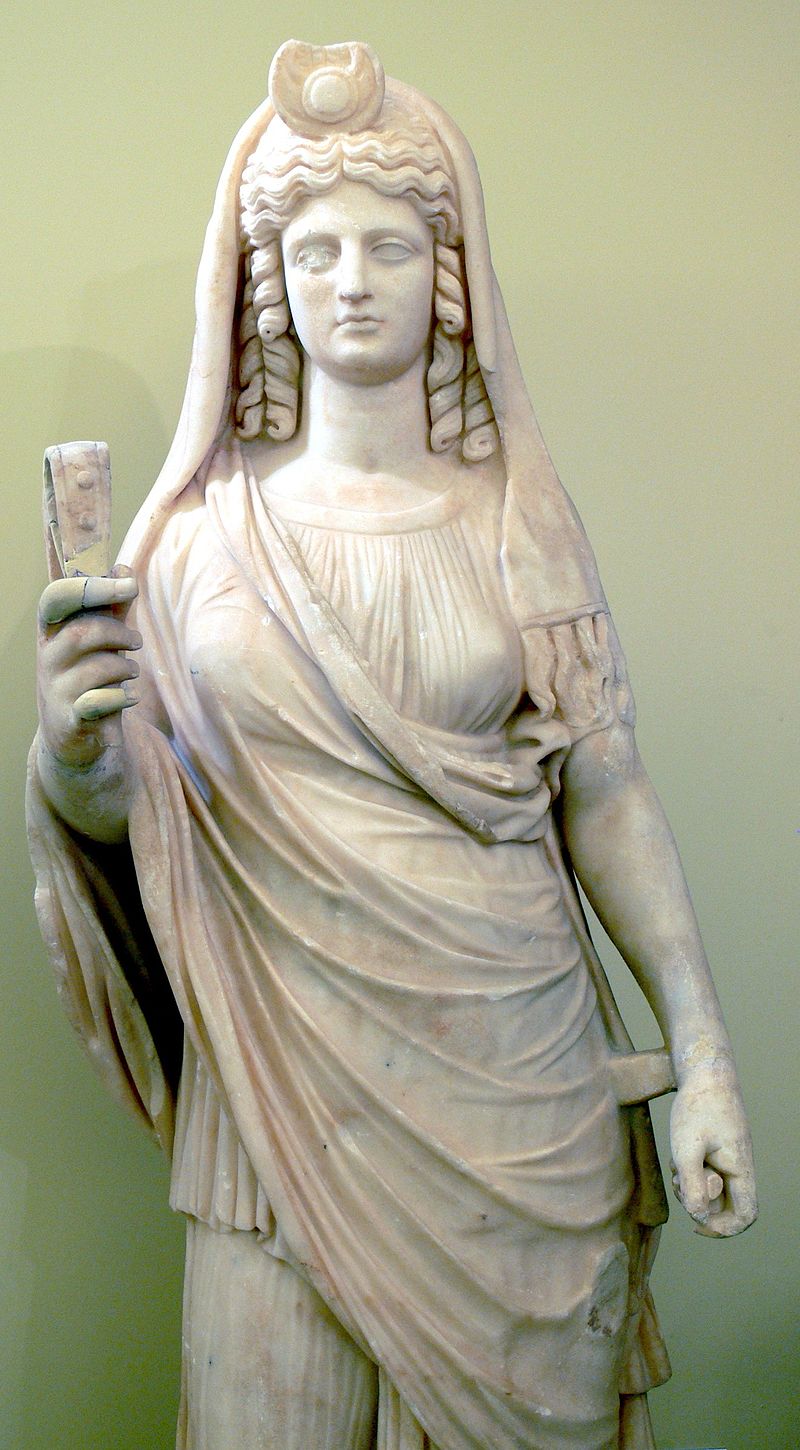
In Greek mythology, Persephone also called Kore or Cora, is the daughter of Zeus and the harvest goddess Demeter, and is the queen of the underworld. Homer describes her as the formidable, venerable majestic princess of the underworld, who carries into effect the curses of men upon the souls of the dead.
Persephone was married to Hades, the god-king of the underworld.The myth of her abduction represents her function as the personification of vegetation, which shoots forth in spring and withdraws into the earth after harvest; hence, she is also associated with spring as well as the fertility of vegetation. Similar myths appear in the Orient, in the cults of male gods like Attis, Adonis and Osiris,and in Minoan Crete.
Andromache

In Greek mythology, Andromache was the wife of Hector, daughter of Eetion, and sister to Podes. She was born and raised in the city of Cilician Thebe, over which her father ruled. The name means "man battler" or "fighter of men" (note that there was also a famous Amazon warrior named "Andromache," probably in this meaning) or "man's battle" (i.e. "courage" or "manly virtue"), from the Greek stem ἀνδρ- "man" and μάχη "battle".
During the Trojan War, after Hector was killed by Achilles and the city taken by the Greeks, the Greek herald Talthybius informed her of the plan to kill Astyanax, her son by Hector, by throwing him from the city walls. This act was carried out by Neoptolemus who then took Andromache as a concubine and Hector's brother, Helenus, as a slave. By Neoptolemus, she was the mother of Molossus, and according to Pausanias,of Pielus and Pergamus. When Neoptolemus died, Andromache married Helenus and became Queen of Epirus. Pausanias also implies that Helenus' son, Cestrinus, was by Andromache. Andromache eventually went to live with Pergamus in Pergamum, where she died of old age.

沒有留言:
張貼留言