
Publius Vergilius Maro ; traditional dates October 15, 70 BC – September 21, 19 BC), usually called Virgil or Vergil in English, was an ancient Roman poet of the Augustan period. He is known for three acclaimed works of Latin literature, the Eclogues (or Bucolics), the Georgics, and the epicAeneid. A number of minor poems, collected in the Appendix Vergiliana, are sometimes attributed to him.
Virgil is traditionally ranked as one of Rome's greatest poets. His Aeneid has been considered the national epic of ancient Rome from the time of its composition to the present day. Modeled after Homer's Iliad and Odyssey, the Aeneid follows the Trojan refugeeAeneas as he struggles to fulfill his destiny and arrive on the shores of Italy—in Roman mythology the founding act of Rome. Virgil's work has had wide and deep influence on Western literature, most notably Dante's Divine Comedy, in which Virgil appears as Dante's guide through hell and purgatory.
Aeneid
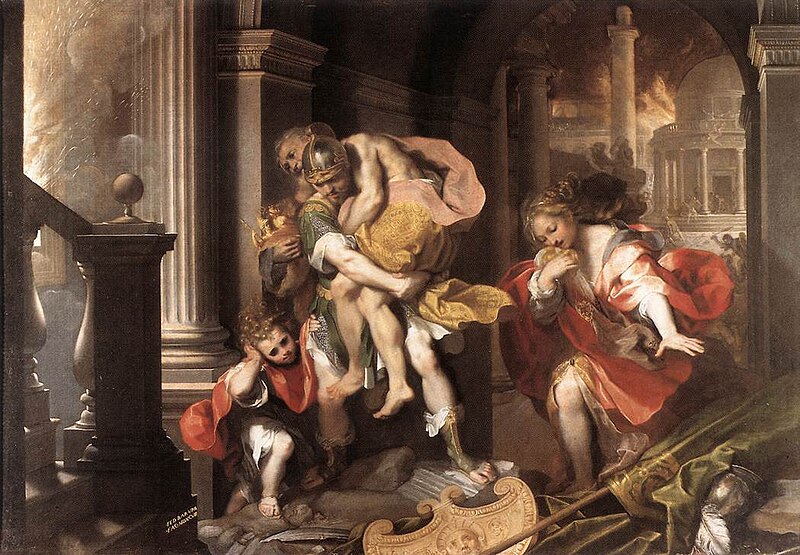
The Aeneid is a Latin epic poem, written by Virgil between 29 and 19 BC, that tells the legendary story of Aeneas, a Trojan who travelled to Italy, where he became the ancestor of the Romans. It comprises 9,896 lines in dactylic hexameter. The first six of the poem's twelve books tell the story of Aeneas's wanderings from Troy to Italy, and the poem's second half tells of the Trojans' ultimately victorious war upon the Latins, under whose name Aeneas and his Trojan followers are destined to be subsumed.
The hero Aeneas was already known to Greco-Roman legend and myth, having been a character in the Iliad. Virgil took the disconnected tales of Aeneas's wanderings, his vague association with the foundation of Rome and a personage of no fixed characteristics other than a scrupulous pietas, and fashioned this into a compelling founding myth or national epic that at once tied Rome to the legends of Troy, explained the Punic Wars, glorified traditional Roman virtues, and legitimized the Julio-Claudian dynasty as descendants of the founders, heroes, and gods of Rome and Troy.
The Aeneid is widely regarded as Virgil's masterpiece and one of the greatest works of Latin literature.
Extra information
Shakespeare's sonnets

Shakespeare's Sonnets is the title of a collection of 154 sonnets by William Shakespeare, which covers themes such as the passage of time, love, beauty and mortality. The first 126 sonnets are addressed to a young man; the last 28 to a woman.
The sonnets to the young man express overwhelming, obsessional love. The main issue of debate has always been whether it remained platonic or became physical.The first 17 poems, traditionally called the procreation sonnets, are addressed to the young man urging him to marry and have children in order to immortalize his beauty by passing it to the next generation. Other sonnets express the speaker's love for the young man; brood upon loneliness, death, and the transience of life; seem to criticise the young man for preferring a rival poet; express ambiguous feelings for the speaker's mistress; and pun on the poet's name. The final two sonnets are allegorical treatments of Greek epigrams referring to the "little love-god" Cupid.

沒有留言:
張貼留言