
In Homer's Odyssey, Penelope is the wife of Odysseus, who is known for her faithfulness to Odysseus while he is absent, despite having many suitors.
Her name has traditionally been associated with marital faithfulness, and so it was with the Greeks and Romans, but some recent feminist readings offer a more ambiguous interpretation. Her character is beyond what was available to most women at the time, and she is considered a match for Odysseus due to her immense strength, warmth and intelligence.
Penelope is the wife of the main character, the king of Ithaca, Odysseus (Ulysses in Roman mythology), and daughter of Icarius and his wife Periboea. She only has one son by Odysseus, Telemachus, who was born just before Odysseus was called to fight in the Trojan War. She waits twenty years for the final return of her husband, during which she devises various strategies to delay marrying one of the 108 suitors (led by Antinous and including Agelaus, Amphinomus, Ctessippus, Demoptolemus, Elatus, Euryades, Eurymachus and Peisandros).
On Odysseus's return, disguised as an old beggar, he finds that Penelope has remained faithful. She has devised tricks to delay her suitors, one of which is to pretend to be weaving a burial shroud for Odysseus's elderly father Laertes and claiming that she will choose a suitor when she has finished. Every night for three years, she undoes part of the shroud, until Melantho, one of twelve unfaithful serving women, discovers her chicanery and reveals it to the suitors.
Calypso
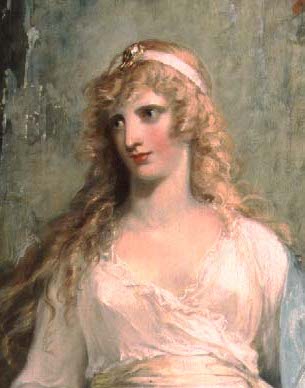
Calypso was a nymph in Greek mythology, who lived on the island of Ogygia, where she detained Odysseus for several years. She is generally said to be the daughter of the Titan Atlas.
Hesiod, and the Homeric Hymn to Demeter, mention either a different Calypso or possibly the same Calypso as one of the Oceanid daughters of Tethys and Oceanus.Apollodorus includes the name Calypso in his list of Nereids, the daughters of Nereus and Doris.
Demeter

In ancient Greek religion and Greek mythology, Demeter is the goddess of the harvest and agriculture, who presided over grains and the fertility of the earth. Her cult titles include Sito (Σι τώ), "she of the Grain", as the giver of food or grain, and Thesmophoros , "Law-Bringer," as a mark of the civilized existence of agricultural society.
Though Demeter is often described simply as the goddess of the harvest, she presided also over the sacred law, and the cycle of life and death. She and her daughter Persephone were the central figures of the Eleusinian Mysteries that predated the Olympian pantheon. In the Linear B Mycenean Greek tablets of circa 1400–1200 BC found at Pylos, the "two mistresses and the king" may be related with Demeter, Persephone and Poseidon. Her Roman equivalent is Ceres.

沒有留言:
張貼留言