2017年1月7日 星期六

week13

Aristophanes

「aristofanes obras」的圖片搜尋結果


Aristophanes ; (c. 446 – c. 386 BC), son of Philippus, of the deme Kydathenaion (Latin: Cydathenaeum), was a comic playwright of ancient Athens. Eleven of his forty plays survive virtually complete. These, together with fragments of some of his other plays, provide the only real examples of a genre of comic drama known as Old Comedy, and are used to define it.

Also known as the Father of Comedy and the Prince of Ancient Comedy, Aristophanes has been said to recreate the life of ancient Athens more convincingly than any other author. His powers of ridicule were feared and acknowledged by influential contemporaries; Plato singled out Aristophanes' play The Clouds as slander that contributed to the trial and subsequent condemning to death of Socrates although other satirical playwrights had also caricatured the philosopher.


Lysistrata

「aubrey beardsley lysistrata」的圖片搜尋結果


Lysistrata is a comedy by Aristophanes. Originally performed in classical Athens in 411 BC, it is a comic account of one woman's extraordinary mission to end the Peloponnesian War. Lysistrata persuades the women of Greece to withhold sexual privileges from their husbands and lovers as a means of forcing the men to negotiate peace—a strategy, however, that inflames the battle between the sexes. The play is notable for being an early exposé of sexual relations in a male-dominated society. Additionally, its dramatic structure represents a shift from the conventions of Old Comedy, a trend typical of the author's career. It was produced in the same year as the Thesmophoriazusae, another play with a focus on gender-based issues, just two years after Athens' catastrophic defeat in the Sicilian Expedition.

week12

Euripides

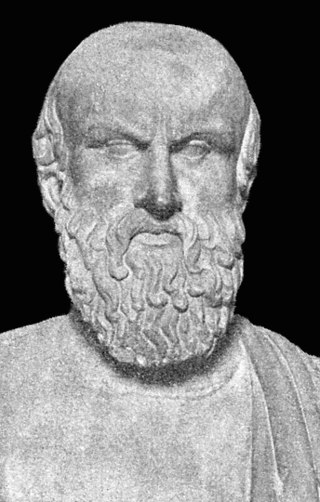
Euripides Pio-Clementino Inv302.jpg

Euripides (c. 480 – c. 406 BC) was a tragedian of classical Athens. He is one of the few whose plays have survived, with the others being Aeschylus, Sophocles, and potentially Euphorion. Some ancient scholars attributed 95 plays to him but according to the Suda it was 92 at most. Of these, 18 or 19 have survived more or less complete (there has been debate about his authorship of Rhesus, largely on stylistic grounds) and there are also fragments, some substantial, of most of the other plays. More of his plays have survived intact than those of Aeschylus and Sophocles together, partly due to mere chance and partly because his popularity grew as theirs declined—he became, in the Hellenistic Age, a cornerstone of ancient literary education, along with Homer, Demosthenes and Menander.

Euripides is identified with theatrical innovations that have profoundly influenced drama down to modern times, especially in the representation of traditional, mythical heroes as ordinary people in extraordinary circumstances. This new approach led him to pioneer developments that later writers adapted to comedy, some of which are characteristic of romance. Yet he also became "the most tragic of poets", focusing on the inner lives and motives of his characters in a way previously unknown. He was "the creator of...that cage which is the theatre of Shakespeare's Othello, Racine's Phèdre, of Ibsen and Strindberg," in which "...imprisoned men and women destroy each other by the intensity of their loves and hates", and yet he was also the literary ancestor of comic dramatists as diverse as Menander and George Bernard Shaw.

Medea(play)

Medea Peter Stein 2005.jpg


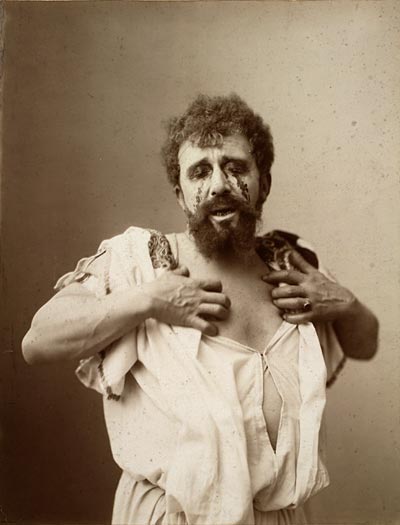
Medea  is an ancient Greek tragedy written by Euripides, based upon the myth of Jason and Medea and first produced in 431 BC. The plot centers on the actions of Medea, a former princess of the "barbarian" kingdom of Colchis, and the wife of Jason; she finds her position in the Greek world threatened as Jason leaves her for a Greek princess of Corinth. Medea takes vengeance on Jason by killing Jason's new wife as well as her own children with him, after which she escapes to Athens to start a new life.

Considered shocking to Euripedes' contemporaries, Medea and the suite of plays that it accompanied in the City Dionysia festival came last in the festival that year. Nonetheless the play remained part of the tragedic repertoire, and experienced renewed interest with the emergence of the feminist movement, because of its nuanced and sympathetic portrayal of Medea's struggle to take charge of her own life in a male-dominated world. The play has remained the most frequently performed Greek tragedy through the 20th century.

week11

Sophocles

Sophocles pushkin.jpg

Sophocles  is one of three ancient Greek tragedians whose plays have survived. His first plays were written later than those of Aeschylus, and earlier than or contemporary with those of Euripides. Sophocles wrote 120 plays during the course of his life, but only seven have survived in a complete form: Ajax, Antigone, The Women of Trachis, Oedipus the King, Electra, Philoctetes and Oedipus at Colonus. For almost 50 years, Sophocles was the most celebrated playwright in the dramatic competitions of the city-state of Athens that took place during the religious festivals of the Lenaea and the Dionysia. He competed in 30 competitions, won 18, and was never judged lower than second place. Aeschylus won 14 competitions, and was sometimes defeated by Sophocles, while Euripides won 5 competitions.

The most famous tragedies of Sophocles feature Oedipus and also Antigone: they are generally known as the Theban plays, although each play was actually a part of a different tetralogy, the other members of which are now lost. Sophocles influenced the development of the drama, most importantly by adding a third actor, thereby reducing the importance of the chorus in the presentation of the plot. He also developed his characters to a greater extent than earlier playwrights such as Aeschylus.


Oedipus Rex

Oedipus.jpg


Oedipus Rex, also known by its Greek title, Oedipus Tyrannus , or Oedipus the King, is an Athenian tragedy by Sophocles that was first performed around 429 BC. Originally, to the ancient Greeks, the title was simply Oedipus (Οἰδίπους), as it is referred to by Aristotle in the Poetics. It is thought to have been renamed Oedipus Tyrannus to distinguish it from Oedipus at Colonus. In antiquity, the term “tyrant” referred to a ruler, but it did not necessarily have a negative connotation.

Of his three Theban plays that have survived, and that deal with the story of Oedipus, Oedipus Rex was the second to be written. However, in terms of the chronology of events that the plays describe, it comes first, followed by Oedipus at Colonus and then Antigone.


Drama

Comic and tragic masks, symbols of the ancient Greek Muses, Thalia and Melpomene.


Drama is the specific mode of fiction represented in performance. The term comes from a Greek word meaning "action" , which is derived from "to do" . The two masks associated with drama represent the traditional generic division between comedy and tragedy. They are symbols of the ancient Greek Muses, Thalia, and Melpomene. Thalia was the Muse of comedy (the laughing face), while Melpomene was the Muse of tragedy (the weeping face). Considered as a genre of poetry in general, the dramatic mode has been contrasted with the epic and the lyrical modes ever since Aristotle's Poetics (c. 335 BCE)—the earliest work of dramatic theory.

In English (as was the analogous case in many other European languages), the word "play" or "game" (translating the Anglo-Saxon plèga or Latin ludus) was the standard term used to describe drama until William Shakespeare's time—just as its creator was a "play-maker" rather than a "dramatist" and the building was a "play-house" rather than a "theatre." The use of "drama" in a more narrow sense to designate a specific type of play dates from the modern era. "Drama" in this sense refers to a play that is neither a comedy nor a tragedy—for example, Zola's Thérèse Raquin (1873) or Chekhov's Ivanov (1887). It is this narrower sense that the film and television industries, along with film studies, adopted to describe "drama" as a genre within their respective media. "Radio drama" has been used in both senses—originally transmitted in a live performance, it has also been used to describe the more high-brow and serious end of the dramatic output of radio.

week10

Tragedy

Tragedy  is a form of drama based on human suffering that invokes an accompanying catharsis or pleasure in audiences. While many cultures have developed forms that provoke this paradoxical response, the term tragedy often refers to a specific tradition of drama that has played a unique and important role historically in the self-definition of Western civilisation. That tradition has been multiple and discontinuous, yet the term has often been used to invoke a powerful effect of cultural identity and historical continuity—"the Greeks and the Elizabethans, in one cultural form; Hellenes and Christians, in a common activity," as Raymond Williams puts it.

From its origins in the theatre of ancient Greece 2500 years ago, from which there survives only a fraction of the work of Aeschylus, Sophocles and Euripides; through its singular articulations in the works of Shakespeare, Lope de Vega, Jean Racine, and Friedrich Schiller to the more recent naturalistic tragedy of August Strindberg; Samuel Beckett's modernist meditations on death, loss and suffering; Müller's postmodernist reworkings of the tragic canon; and Joshua Oppenheimer's incorporation of tragic pathos in his nonfiction film, The Act of Killing (2012), tragedy has remained an important site of cultural experimentation, negotiation, struggle, and change. A long line of philosophers—which includes Plato, Aristotle, Saint Augustine, Voltaire, Hume, Diderot, Hegel, Schopenhauer, Kierkegaard, Nietzsche, Freud, Benjamin, Camus, Lacan, and Deleuze—have analysed, speculated upon, and criticised the genre.

Aeschylus

Aischylos Büste.jpg


Aeschylus  was an ancient Greek tragedian. He is often described as the father of tragedy.Critics' and scholars' knowledge of the genre begins with his work, and understanding of earlier tragedies is largely based on inferences from his surviving plays. According to Aristotle, he expanded the number of characters in theater allowing conflict among them; characters previously had interacted only with the chorus.

Agamemnon

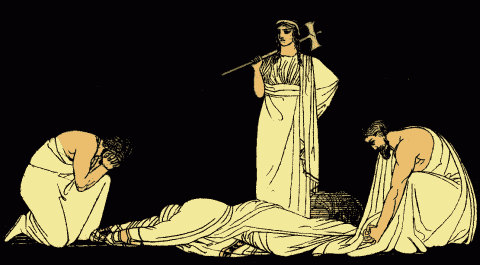
The Murder Of Agamemnon - Project Gutenberg eText 14994.png


The play Agamemnon details the homecoming of Agamemnon, King of Mycene, from the Trojan War. After 10 years of warfare, Troy had fallen and all of Greece could lay claim to victory. Waiting at home for Agamemnon is his wife, Queen Clytemnestra, who has been planning his murder. She desires his death to avenge the sacrifice of her daughter Iphigenia, to exterminate the only thing hindering her from commandeering the crown, and finally be able to publicly embrace her long-time-lover Aegisthus. This play is first of the three within the Oresteia trilogy.

The play opens to a watchman looking down and over the sea, reporting that he has been lying restless "like a dog" for a year, waiting to see some sort of signal confirming a Greek victory in Troy. He laments the fortunes of the house, but promises to keep silent: "A huge ox has stepped onto my tongue.". The watchman sees a light far off in the distance and is overjoyed at the victory and hopes for the hasty return of his King as the house has "wallowed". Clytaemnestra is introduced to the audience and she declares that there will be celebrations and sacrifices throughout the city as Agamemnon and his army return. Clytaemnestra's encounters with the Leader, the chorus, and other males within the artistocracy are a manifestation of the sexism within Ancient Greek Society.

week9

Midterm exam

2017年1月6日 星期五

week8

Aeneas


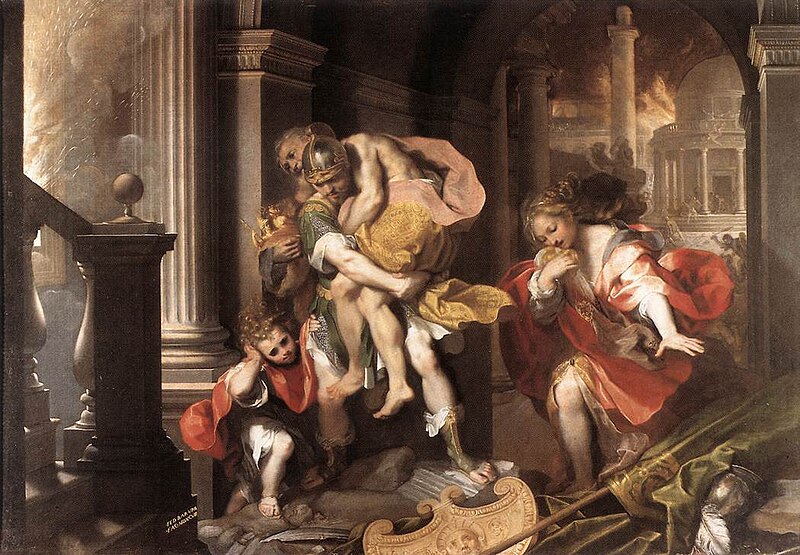
In Greco-Roman mythology, Aeneas  was a Trojan hero, the son of the prince Anchises and the goddess Venus (Aphrodite). His father was a first cousin of King Priam of Troy (both being grandsons of Ilus, founder of Troy), making Aeneas a second cousin to Priam's children (such as Hector and Paris). He is a character in Greek mythology and is mentioned in Homer's Iliad. Aeneas receives full treatment in Roman mythology, most extensively in Virgil's Aeneid, where he is an ancestor of Romulus and Remus. He became the first true hero of Rome. Snorri Sturlason identifies him with the Norse Æsir Vidarr.


Pygmalion

「pygmalion」的圖片搜尋結果


Pygmalion  is a legendary figure of Cyprus. Though Pygmalion is the Greek version of the Phoenician royal name Pumayyaton, he is most familiar from Ovid's narrative poem Metamorphoses, in which Pygmalion was a sculptor who fell in love with a statue he had carved.

In Ovid's narrative, Pygmalion was a Cypriot sculptor who carved a woman out of ivory. According to Ovid, after seeing the Propoetides he was "not interested in women", but his statue was so beautiful and realistic that he fell in love with it.

In time, Aphrodite's festival day came, and Pygmalion made offerings at the altar of Aphrodite. There, too scared to admit his desire, he quietly wished for a bride who would be "the living likeness of my ivory girl." When he returned home, he kissed his ivory statue, and found that its lips felt warm. He kissed it again, and found that the ivory had lost its hardness. Aphrodite had granted Pygmalion's wish.

Sisyphus


In Greek mythology Sisyphus  was the king of Ephyra (now known as Corinth). He was punished for his self-aggrandizing craftiness and deceitfulness by being forced to roll an immense boulder up a hill, only to watch it come back to hit him, repeating this action for eternity. Through the classical influence on modern culture, tasks that are both laborious and futile are therefore described as Sisyphean.

week7

Virgil

「virgil」的圖片搜尋結果


Publius Vergilius Maro ; traditional dates October 15, 70 BC – September 21, 19 BC), usually called Virgil or Vergil  in English, was an ancient Roman poet of the Augustan period. He is known for three acclaimed works of Latin literature, the Eclogues (or Bucolics), the Georgics, and the epicAeneid. A number of minor poems, collected in the Appendix Vergiliana, are sometimes attributed to him.

Virgil is traditionally ranked as one of Rome's greatest poets. His Aeneid has been considered the national epic of ancient Rome from the time of its composition to the present day. Modeled after Homer's Iliad and Odyssey, the Aeneid follows the Trojan refugeeAeneas as he struggles to fulfill his destiny and arrive on the shores of Italy—in Roman mythology the founding act of Rome. Virgil's work has had wide and deep influence on Western literature, most notably Dante's Divine Comedy, in which Virgil appears as Dante's guide through hell and purgatory.

Aeneid


The Aeneid  is a Latin epic poem, written by Virgil between 29 and 19 BC, that tells the legendary story of Aeneas, a Trojan who travelled to Italy, where he became the ancestor of the Romans. It comprises 9,896 lines in dactylic hexameter. The first six of the poem's twelve books tell the story of Aeneas's wanderings from Troy to Italy, and the poem's second half tells of the Trojans' ultimately victorious war upon the Latins, under whose name Aeneas and his Trojan followers are destined to be subsumed.

The hero Aeneas was already known to Greco-Roman legend and myth, having been a character in the Iliad. Virgil took the disconnected tales of Aeneas's wanderings, his vague association with the foundation of Rome and a personage of no fixed characteristics other than a scrupulous pietas, and fashioned this into a compelling founding myth or national epic that at once tied Rome to the legends of Troy, explained the Punic Wars, glorified traditional Roman virtues, and legitimized the Julio-Claudian dynasty as descendants of the founders, heroes, and gods of Rome and Troy.

The Aeneid is widely regarded as Virgil's masterpiece and one of the greatest works of Latin literature.


Extra information

Shakespeare's sonnets

「shakespeare sonnet」的圖片搜尋結果


Shakespeare's Sonnets is the title of a collection of 154 sonnets by William Shakespeare, which covers themes such as the passage of time, love, beauty and mortality. The first 126 sonnets are addressed to a young man; the last 28 to a woman.

The sonnets to the young man express overwhelming, obsessional love. The main issue of debate has always been whether it remained platonic or became physical.The first 17 poems, traditionally called the procreation sonnets, are addressed to the young man urging him to marry and have children in order to immortalize his beauty by passing it to the next generation. Other sonnets express the speaker's love for the young man; brood upon loneliness, death, and the transience of life; seem to criticise the young man for preferring a rival poet; express ambiguous feelings for the speaker's mistress; and pun on the poet's name. The final two sonnets are allegorical treatments of Greek epigrams referring to the "little love-god" Cupid.